
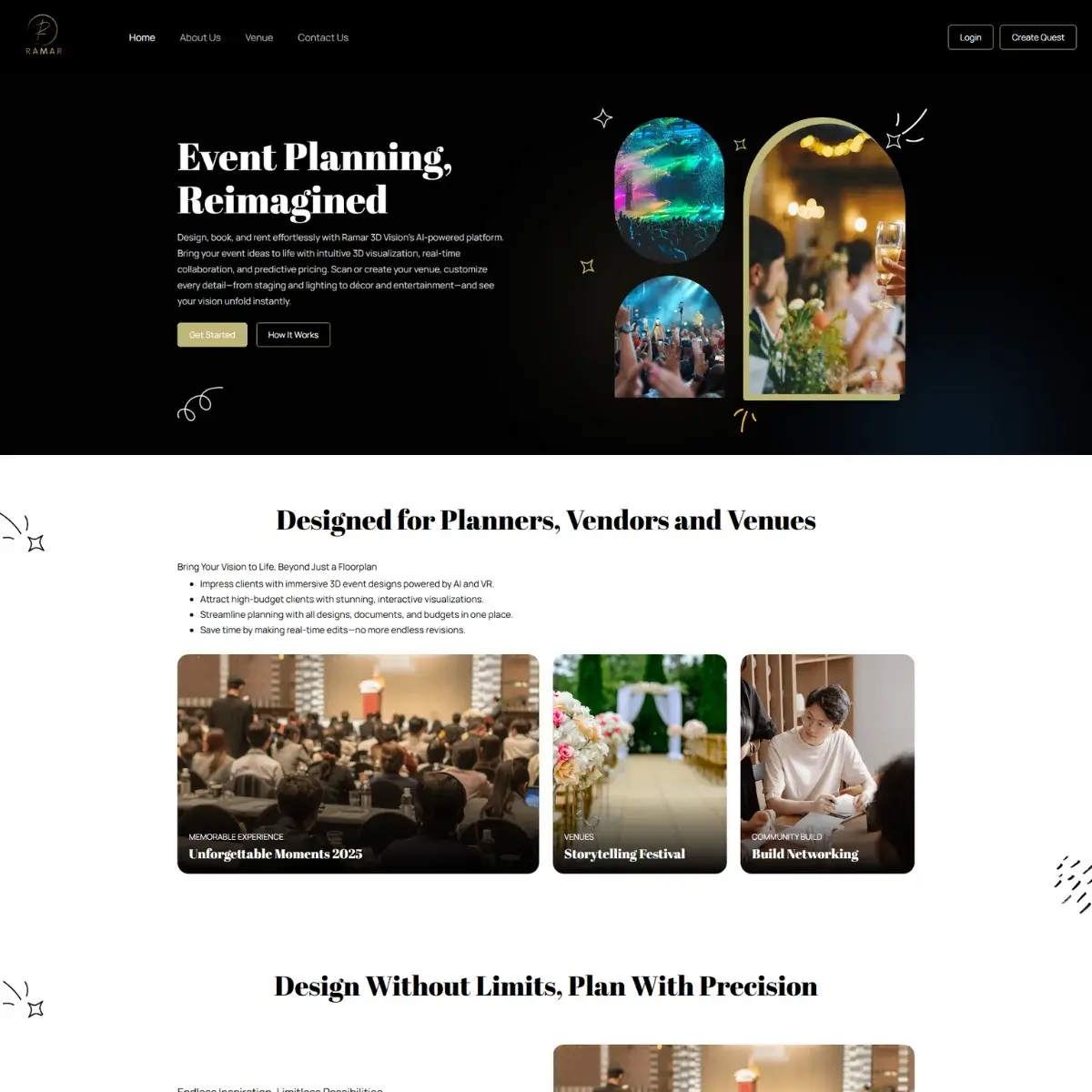
Project Overview
Ramarverse is a cutting-edge event planning platform that bridges the gap between static inspiration and interactive design. Unlike traditional planning sites, Ramarverse offers a dedicated “Design Universe” where users can take a base image of a venue or setting and use a custom-built whiteboard system to add, arrange, and manipulate decorative elements. This allows planners and clients to visualize a fully decorated event space before a single piece of furniture is moved.
The Case Study: Engineering a Dynamic Design Canvas
1. The Challenge: From Static Design to Interactive Logic
The primary challenge was two-fold: first, converting a highly sophisticated and aesthetic Figma design into a responsive React application with 100% fidelity. Second, and more importantly, building a “Whiteboard/Canvas” engine from scratch. The client required a system where users could interact with a base image as a “layer” and overlay various decorative assets while maintaining proportion, orientation, and ease of use.
2. Technical Obstacles
Layer Management: Developing a logic that distinguishes between the background (venue image) and the foreground (decorative elements) to prevent accidental shifts.
State Persistence: Ensuring that the position, scale, and rotation of every decorative element are tracked accurately within the React state to allow for saving or exporting designs.
Performance: Rendering multiple high-resolution decorative assets on a single canvas without causing lag or UI stuttering during the “drag-and-drop” process.
3. The Solution: Custom React Canvas Engine
I utilized React.js to build a modular architecture where each decorative element is treated as a dynamic component.
Interactive Canvas: I implemented an interactive layer system that allows users to upload their own base images or choose from templates.
Asset Manipulation: Built custom hooks to handle the transformation (scaling/rotating) of decorative elements, ensuring the UX feels fluid and “snappy.”
Figma-to-Code Precision: Every button, margin, and shadow was hand-coded to match the original Figma files, ensuring the premium “Event Planner” brand aesthetic was preserved.
4. The Outcome
Ramarverse has evolved from a simple concept into a powerful visualization tool for the event industry. Users can now create professional-grade event mockups in minutes. The platform successfully demonstrates how custom frontend engineering can turn a standard service website into a functional, value-added software product.
Key Highlights
Interactive Whiteboard System: A unique “Drag, Drop, and Decorate” engine for real-time event visualization.
High-Fidelity React Development: Seamlessly translated complex Figma mockups into a fast, responsive, and pixel-perfect web application.
Custom Asset Management: A dedicated library of decorative elements that users can easily apply to their venue images.
Advanced UI/UX: A sleek, modern interface designed specifically for the creative and aesthetic needs of event professionals.
🛠 Technology Stack:
Frontend Framework: React.js (Component-based architecture).
State Management: React Context / Hooks for real-time canvas updates.
Styling: Tailwind CSS or Styled Components (for high-fidelity design implementation).
Canvas Technology: HTML5 Canvas API / Fabric.js (for advanced image and element manipulation).
Design Tool: Figma (Source of truth for UI/UX).
Deployment: Vercel/Netlify for optimized frontend delivery.
Your Project Could Be Next. Got a problem worth solving? Let's talk.